

Aesop’s Fables in Jamaican Patois – with audio
Table of Contents show
Dunno about you, but over here at Language Hobo, we find that almost everything is a gazillion times funnier when said in Jamaican Patois. Jamaicans just have this colourful, animated way of putting things – both in terms of phrasing and the accent itself.
I grew up listening to Jamaicans speak all around me, and even as an adult, it never gets old.

That’s why I’m excited to bring you guys some of Aesop’s fables (5, to be exact) that have been translated into Jamaican Patois, along with native audio, so that you, too, can enjoy the language as much as we do.
Note: We use Cassidy/JLU orthography, so spellings might look a bit odd if you’re used to something else.
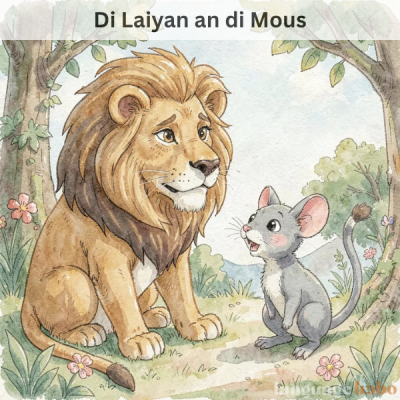
Di Laiyan an di Mous – The Lion and the Mouse
| Jamaican Patois | English |
|---|---|
| Wan Laiyan did a sliip, an wan Mous ron uova im fies an wiek im op. Im jomp op beks, kech di Mous, an did a go kil im, wen di Mous beg im, a se: “Ef yu wuda jos mek mi liv, mi wi pie yu bak fi yu kainniss.” Di Laiyan laaf an mek im go. Likl wail afta dat, som onta kech di Laiyan an tai im dong a grong wid chrang ruop. Di Mous ier im a ruor an nuo a im, so im kom an nyam di ruop wid im tiit an set im frii, a se: “Yu did laaf se mi kudn neva elp yu, an yu neva did a luk fi notn bak fram mi; nou yu nuo se iivn wan Mous kyan du gud fi wan Laiyan.” | A Lion was awakened from sleep by a Mouse running over his face. Rising up angrily, he caught him and was about to kill him, when the Mouse piteously entreated, saying: “If you would only spare my life, I would be sure to repay your kindness.” The Lion laughed and let him go. It happened shortly after this that the Lion was caught by some hunters, who bound him to the ground with strong ropes. The Mouse, recognising his roar, came and gnawed the rope with his teeth, and set him free, exclaiming: “You ridiculed the idea of my ever being able to help you, not expecting to receive from me any repayment of your favour; now you know that it is possible for even a Mouse to confer benefits on a Lion.” |
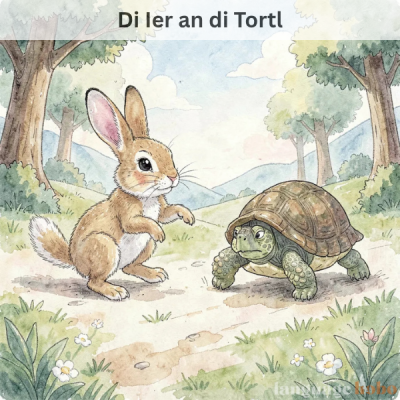
Di Ier an di Tortl – The Hare and the Tortoise
| Jamaican Patois | English |
|---|---|
| Wan die, wan Ier did a laaf aafa di Tortl fi im shaat fut an im sluo sluo waak. Di Tortl laaf an se: “Iivn ef yu faas laik di briiz, mi wi biit yu iina wan ries.” Di Ier tingk se dat kyaahn neva go so, so im grii, an dem wok out se di Faks fi pik di ruod an se we di ries fi en. Pan di die we dem set fi di ries, di tuu a dem staat aaf tugeda. Di Tortl neva tap fi wan minit, bot im kip aan a go sluo an stedi, chriet tu di en a di ruod. Di Ier lidong a ruodsaid an jrap aaf a sliip. Wen im wiek op an ron az faas az im kuda ron, im si se di Tortl did don riich, an a tek wan nais likl nap afta im did taiyad. Sluo bot stedi win di ries. | A Hare one day ridiculed the short feet and slow pace of the Tortoise, who replied, laughing: “Though you be swift as the wind, I will beat you in a race.” The Hare, believing her assertion to be simply impossible, assented to the proposal; and they agreed that the Fox should choose the course and fix the goal. On the day appointed for the race the two started together. The Tortoise never for a moment stopped, but went on with a slow but steady pace straight to the end of the course. The Hare, lying down by the wayside, fell fast asleep. At last waking up, and moving as fast as he could, he saw the Tortoise had reached the goal, and was comfortably dozing after her fatigue. Slow but steady wins the race. |
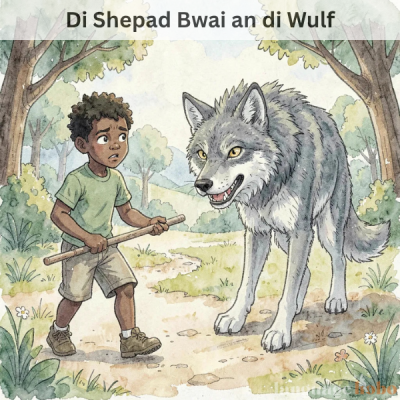
Di Shepad Bwai an di Wulf – The Shepherd’s Boy and the Wolf
| Jamaican Patois | English |
|---|---|
| Wan shepad bwai did a luk aafa som shiip nier wan toun. Chrii ar fuo taim im baal out, “Wulf! Wulf!” an mek di piipl dem fram di toun kom out, an wen im nieba dem kom fi elp im, im laaf aafa dem. Bot afta aal dat, di Wulf kom fi chuu. Nou di shepad bwai fried fi chuu, an im baal out: “Du, kom elp mi! Di Wulf a kil di shiip dem!” Bot nobadi neva pie im no main, an nobadi neva kom elp im. Di Wulf neva av notn fi fried, so im tek im taim an tier op aal a di shiip dem. Yu kyaahn biliiv wan laiyad, iivn wen im a taak di chuut. | A Shepherd-boy, who watched a flock of sheep near a village, brought out the villagers three or four times by crying out, “Wolf! Wolf!” and when his neighbours came to help him, laughed at them for their pains. The Wolf, however, did truly come at last. The Shepherd-boy, now really alarmed, shouted in an agony of terror: “Pray, do come and help me; the Wolf is killing the sheep;” but no one paid any heed to his cries, nor rendered any assistance. The Wolf, having no cause of fear, at his leisure lacerated or destroyed the whole flock. There is no believing a liar, even when he speaks the truth. |
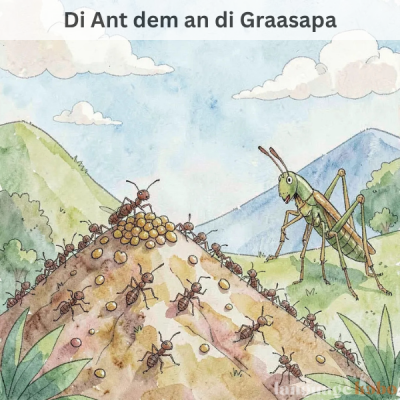
Di Ant dem an di Graasapa – The Ants and the Grasshopper
| Jamaican Patois | English |
|---|---|
| Wan nais winta die, di ant dem did a jrai out di grien we dem did gyada iina di soma. Wan Graasapa we did a ded fi onggri paas bai, an beg dem fi likl fuud. Di ant dem aks im se: “Wa mek yu neva stuor op som fuud iina di soma?” Im se: “Mi neva av no taim. Mi did a sing aal die.” Den dem laaf aafa im an se: “Ef yu did fuul inof fi sing aal chuu di soma, den yu afi daans go a bed widout yu sopa iina di winta.” | The Ants were spending a fine winter’s day drying grain collected in the summertime. A Grasshopper, perishing with famine, passed by and earnestly begged for a little food. The Ants inquired of him, “Why did you not treasure up food during the summer?” He replied, “I had not leisure enough. I passed the days in singing.” They then said in derision: “If you were foolish enough to sing all the summer, you must dance supperless to bed in the winter.” |
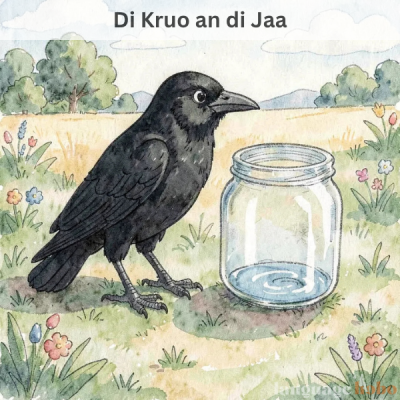
Di Kruo an di Jaa – The Crow and the Pitcher
| Jamaican Patois | English |
|---|---|
| Wan Kruo we did a ded fi torst si wan jaa, an im flai go de glad-glad, a uop se im wuda fain waata. Wen im riich, im sad fi si se it onggl av likl-likl waata dong a batam, so im kudn get it at aal. Im chrai evriting im kuda tingk a fi riich di waata, bot notn neva wok. Den im gyada op az moch stuon az im kuda kyari, an jrap dem iina di jaa wan bai wan wid im biik, til di waata kom op we im kuda riich it, an so im siev im laif. Wen yu niid sitn bad, yu wi fain wan wie fi get it. | A Crow perishing with thirst saw a pitcher, and hoping to find water, flew to it with delight. When he reached it, he discovered to his grief that it contained so little water that he could not possibly get at it. He tried everything he could think of to reach the water, but all his efforts were in vain. At last he collected as many stones as he could carry and dropped them one by one with his beak into the pitcher, until he brought the water within his reach and thus saved his life. Necessity is the mother of invention. |


